
Insights
Building Trusting Relationships and Co-Developing the Work
From Approach to Impact: How Partnership Is the Key to Driving Educational Change

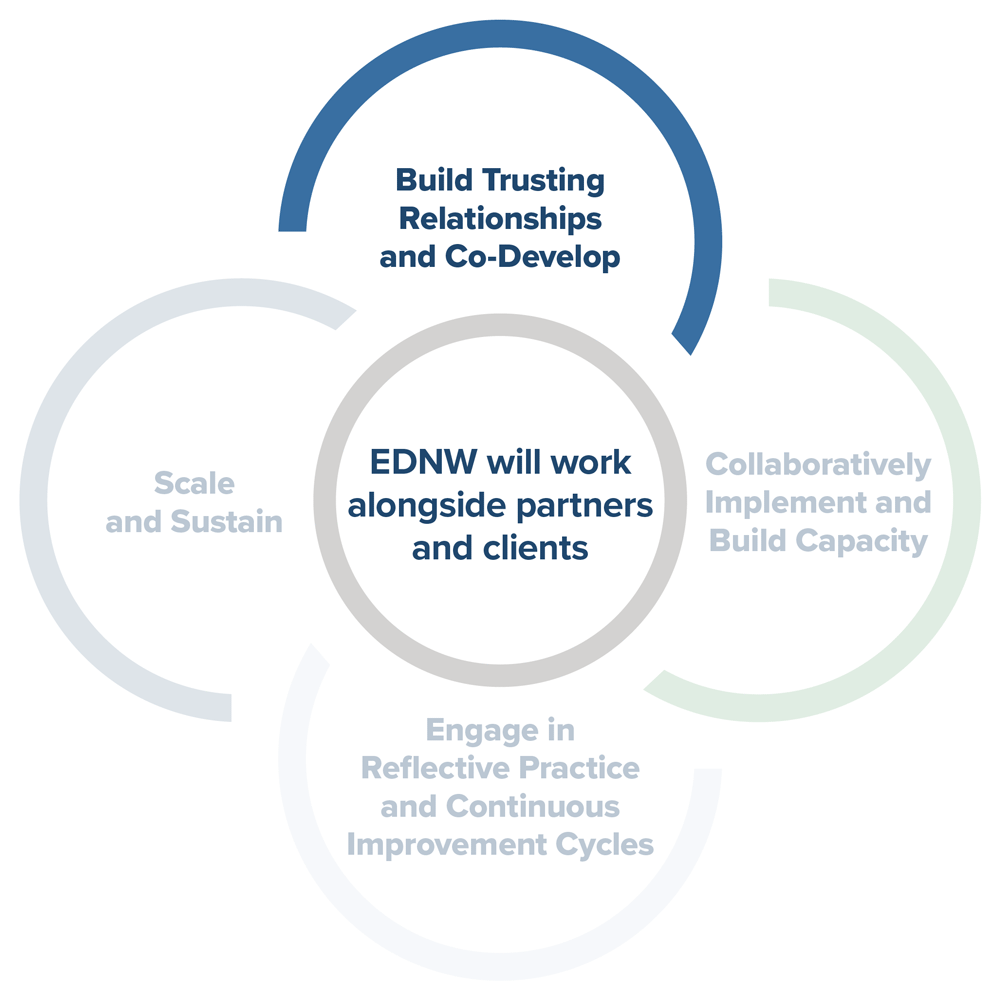
This is the first in a four-part blog series exploring the Northwest Comprehensive Center’s approach to helping state education partners meet their goals.
Lasting educational change begins with strong relationships. Early investment in trust, shared understanding, and co-developed plans creates the conditions for meaningful collaboration and long-term impact. Across NWCC projects, we begin by listening to our partners, understanding their context, and ensuring that the work reflects their priorities rather than a prescribed approach.
The examples below illustrate how this foundation shapes partnerships across the Northwest – from strengthening collaboration among Native Education leaders to supporting Montana in developing a state-led intensive assistance process.
Grounding the Work in Community Needs and Lived Experiences Across the Northwest
The Regional Native Education Network project brings together Native Education leaders in Alaska, Idaho, Montana, Oregon, and Washington to strengthen educational opportunities for Native students and their families. Project co-leads Mandy Smoker-Broaddus, Montana’s former director of Indian education, and RunningHorse Livingston, an expert in mathematics education and Indigenous pedagogy both bring deep professional expertise, lived experience, and long-established relationships to the work. Together, they understand the opportunities and challenges that come with leading Native Education efforts at the state level.
“It’s a tightknit community, but this is a new way of working together and our partners are putting in an unprecedented level of effort in their roles. So, we spent intensive time doing needs sensing to identify what this group values and what they want to accomplish.”
Through conversations with partners, the team learned that while they value the existing monthly Indigenous Leaders Education Network, they also wanted more opportunities to collaborate across states, build stronger regional relationships, and engage in deeper conversations about shared priorities.
To best meet partners’ needs, and with competing demands on leaders’ schedules, the launch of the network was planned as a virtual gathering scheduled for summer 2026. In the meantime, project leads are working with Native Education partners from states in the region to find ways to support their priorities. In Montana, for instance, NWCC is collaborating with state leaders to design and write tasks based on the state’s Indian Education for All content that will be incorporated in the state’s new proposed mathematics standards.
Supporting State Leadership Through Trust and Co-Development in Montana
When NWCC launched the Montana Intensive Assistance Project, the team built on longstanding relationships with the Office of Public Instruction (OPI) while also quickly establishing relationships with members of a newly formed working group comprising local leaders and experts charged with defining and developing a process for identifying schools.
From the beginning, the goal was not to provide answers, but to create a process that allowed Montana leaders to shape and own the work. The team invested time in developing a shared understanding of the project’s purpose, establishing clear processes, and creating space for working group members to contribute their expertise and perspectives, and to lead key decisions.
An initial two-day, in-person session created a foundation for ongoing collaboration with OPI as they advance the working group’s plan and move toward a first draft of the state’s Intensive Assistance process.
Because the work was built collaboratively, Montana leaders are positioned to carry the work forward with confidence and ownership strengthening support for education leaders across the state.
Looking ahead
Trust and co-development are not simply the starting point of a project – they are what make lasting change possible. When partners help shape both the process and the work itself, they build the ownership needed to sustain improvements long after an engagement ends.
In our next blog in this series, we will explore the second phase of NWCC’s approach: collaborative implementation and capacity building.