
Insights
Inside the Work of Supporting State Education Systems
A Q&A with the Co-Directors of the Northwest Comprehensive Center
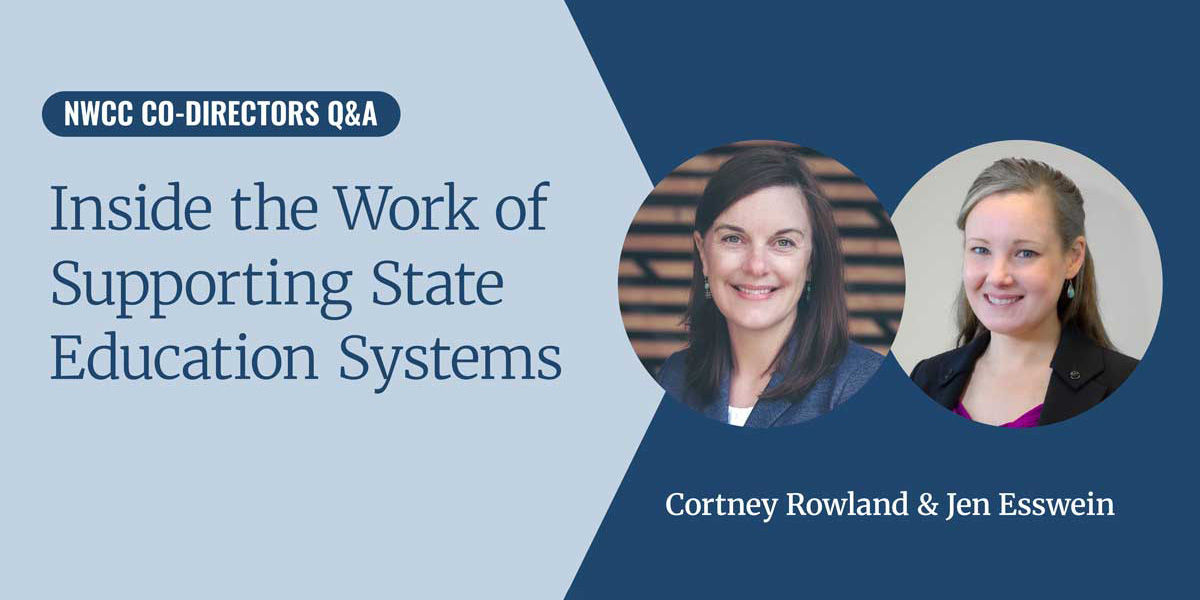
Jen Esswein and Cortney Rowland co-direct the Northwest Comprehensive Center, part of the national Comprehensive Center Network and the designated Regional Center serving Alaska, Idaho, Montana, Oregon, and Washington. Jen and Cortney recently sat down to discuss supporting state education agencies (SEAs) as they navigate growing complexities in education and how the Center helps states turn research and evidence into practical, sustainable solutions for students.
Q: Based on your experience working closely with state education agencies, what are the biggest challenges they are grappling with today?
Cortney: A lot of wonderful things are happening in schools and classrooms across the country, but there are also real challenges with student outcomes and opportunities.
Jen: Yes, states are being asked to improve student outcomes while simultaneously managing funding uncertainty, staffing shortages, and competing policy priorities. And they are often working on very short timelines, which makes the challenge even harder to overcome without support. The challenge isn’t identifying important work—it’s aligning limited capacity around the highest-leverage opportunities.
Cortney: And we constantly remind ourselves of the state’s role in this work. We structure the work of the Center to support states in addressing challenges with things that are under their control.
Q: How does your work help states address those challenges?
Cortney: If you think about the challenges education systems are facing, it can be overwhelming. That’s where the Northwest Comprehensive Center comes in. We help our states set up systems and processes to implement solutions that research has proven to be effective, and we help them make those systems sustainable. We do this in many ways: working with SEAs to understand what’s behind the challenges they’re facing, co-designing solutions rooted in evidence and tailored for the state’s particular needs, facilitating collaboration between key players to implement solutions, measuring progress and course correcting as needed.
The states are the experts in their contexts. Our job is to come alongside them as a thought partner and co-implementer to meet their goals.
Jen: Right. For example, maybe a state needs to design teacher professional development around math. We know that the U.S. Department of Education’s Institute of Education Sciences has toolkits we can use to find teaching practices that have already been researched and found to be effective. We support the SEAs by finding the evidence-based practices that are the best fit and helping them integrate those practices into their program.
Cortney: Right now we’re working with a state to address teacher shortages. A lot of times teacher retention and recruitment is seen as a local issue, but this state is using the levers they have as an SEA to move the needle on that. Given the state’s limited capacity in terms of time, people, and access to the evidence base, our Center is well positioned to help by partnering with a working group to create tools and resources that the SEA and districts can use to recruit and retain teachers. We’re also supporting the state’s campaign to share success stories and promote use of the tools and resources.
Q: What’s involved in running a Regional Comprehensive Center?
Jen: Building relationships. Building trust. I feel like that’s how we’re able to get to the real issues—because we built the trust. We have good relationships with state leaders who all feel like they can just ping us and say, “Hey, can you pop on the phone for 15 minutes?” We’re doing that all the time.
Cortney: The reason they ping us like that is because of the time we have spent building trust. We try to be vulnerable ourselves and not act like we know it all. And we try to meet them where they are. Sometimes a state leader will call just to vent. But that kind of listening and respecting where they are makes them more open to being nudged on something or to hearing something they might not want to hear. They trust us. They know we’ll give good advice and that if we don’t know the answer in the moment, we will work to find it.
Trust is also built through reliability, consistency, and clear communication. That’s why we use high-quality project management, feedback loops, and meeting facilitation techniques that maximize trust-building with our states.
Jen: I love that we have built such strong relationships. And we don’t just have those relationships with SEA leadership. We have strong relationships with folks at every level who own the work.
Cortney: You have to know how to balance the human part of the work with the expertise part of the work. You need both to be effective.
Q: What do you enjoy most about your work?
Cortney: I will say, and I mean this sincerely, that organizations like Education Northwest and federal investments like the Comprehensive Centers are absolutely essential because they’re the link between academia and the classroom. They connect researchers and state and district leaders to schools and classrooms. When I can operationalize that link—when I can see that we are taking something that worked from another state or from the research and help others put it into practice—that’s what I enjoy most about this work.
Jen: I’m just going to tell you the truth, but it might not be a good blog answer. I love hearing that I’m making the best use of the SEAs’ time. That’s where I get my true joy. Their time is extremely valuable, so any time they spend with us on projects costs them something. I’m always asking myself, “Am I making the best use of this 15 minutes?” And I love seeing that our projects are adding the value they need to add, especially given the time that the SEA folks are taking. Before this job, I worked at an SEA, so I have an idea of the weight they are under.
Q: If you could solve one challenge in the education system overnight, what would it be and why?
Cortney: I would invest more in teachers. Teaching is one of the most important jobs, so I would have us work harder to retain good teachers by increasing their salary and instituting practices that better respect the individual and the profession. This can include things like sufficient and ongoing training and mentorship, creating a positive professional climate, and dedicated time for preparation and professional learning.
People don’t think about all the cognitive shifts teachers have to make every day and the incredible expertise and skill needed. They’re educating the people who are going to grow up to make decisions for the country.
Jen: There is so much evidence out there and we have so much data. I would bridge the gap between the evidence and classrooms to get implementation going widely in schools. We know so much about what works, but it’s not fully implemented. If we could put what we know in place in every classroom, we could see more students get the education they need to thrive, to build a good future for themselves.
Cortney: That was the perfect education researcher answer.
Jen: It’s true. Just look at the What Works Clearinghouse. There’s so much evidence. If I could, I would put it to use in classrooms tomorrow. I’m glad we are working with states to be that bridge.
Cortney: Yes, we’re that bridge—a bridge to proven systems and resources SEAs can use to deal with all the competing priorities and complex issues they face.
Jen: Absolutely. SEAs aren’t facing these things alone. We’re partners. We’re here to help.