
Insights
Refining Our Work: Reflection and Continuous Improvement
From Approach to Impact: How Partnership Is the Key to Driving Educational Change
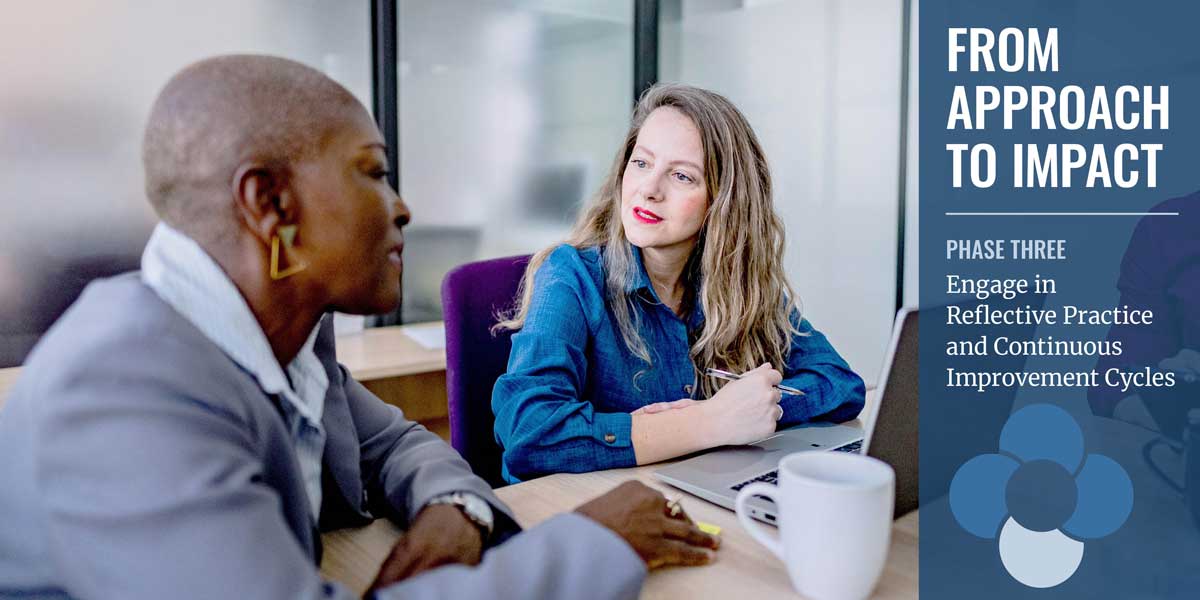
This is the third in a four-part blog series exploring the Northwest Comprehensive Center’s approach to working with state education partners to meet their goals.
Continuous improvement is a pillar of improvement science. With regular data and feedback, we can assess what does and does not work, make changes, and refine our efforts to make a stronger impact over time.
Reflection and continuous improvement is the third phase in the Northwest Comprehensive Center (NWCC) technical assistance approach. It is not an isolated phase; instead, it happens while we collaboratively build and implement projects with our partners. This looks like:
- Gathering frequent feedback from multiple sources to understand how our tools and resources are used and to collect evidence of effectiveness
- Engaging in two-way feedback loops with our partners
- Monitoring for contextual changes and emerging insights
- Reflecting regularly on all data points and adapting as needed
- Supporting our partners to develop and implement their own continuous improvement systems
Context Is Key
A key consideration of our projects is contextual fit. The NWCC serves a diverse five-state region: The education systems span densely populated urban centers and rural-remote communities accessible only by plane or boat.
As we reflect on implementation, we pay close attention to how evidence-based practices fit with local needs, priorities, and context. Using data and feedback, we adjust our approach so the work is tailored to the needs of the community.
Our teacher retention and recruitment work in Alaska focuses on helping educators and collaborators implement strategies from Alaska’s Teacher Retention and Recruitment Playbook, an evidence-based resource developed in 2023. Our work is characterized by strong feedback loops from an intentionally diverse advisory group, which we refer to as the Playbook Implementation Support Team (IST). This group includes rural district personnel, Tribal partners, community organizations, and heavily involved state education agency partners. Layers of feedback from the IST ensured that the tools and resources we develop are appropriate and useful for Alaska’s unique and varied contexts. For example, IST members volunteered to undertake “deep dive” reviews of the resources that most interest them and/or on which they have expertise, in many cases making suggested revisions directly to the drafted resource.
In the long run, taking time to check—and correct—for contextual fit makes it more likely that the tools and resources we develop will be applicable and useful and that initiatives will be sustained over time.
Recruiting and Retaining Educators in Alaska
NWCC is partnering with the Alaska Department of Education and Early Development (DEED) to develop tools that support districts with teacher retention and recruitment—a persistent challenge in a state with many remote and rural communities. The IST was critical to our process for identifying the types of tools that Alaska districts and collaborators need. Our tools include a logic model; how-to guides for districts to conduct needs assessments and develop local action teams and action plans; spotlights on effective district efforts; and informational briefs on teacher testing, hiring, and pay.
We weave continuous improvement throughout the quality assurance process to make sure each tool is useful and well designed. Our process includes at least two internal reviews; one or two reviews from DEED, the IST, and relevant work groups; and, when applicable, member checks. After each review, we incorporate the feedback to improve the tool.
As one example, we heard feedback from the IST that one resource (a memo on teacher compensation strategies used by other states) was not particularly useful because many of the other states described in the resource differed from Alaska in a critical way: Most do not have a unionized educator workforce, whereas—as IST members informed us—Alaska’s teacher workforce is heavily unionized. This matters because it changes a state’s policy options. Policies adopted in nonunionized states may not be allowable by collective bargaining agreements in Alaska. Based on this feedback, and in partnership with DEED, we pivoted to develop an inventory of existing Alaska-focused resources on teacher retention and recruitment that span research and strategies used across the state. We included the set of resources as an appendix in a separate article focused on the history of teacher pay in Alaska. We also invited IST members to review all the materials developed through the project at multiple points: at the concept phase, in whole group discussion of the logic model, in small group discussion on specific articles, and in deep-dive reviews of completed drafts.
Reflection and continuous improvement apply not only to products, but also to our engagement process. We seek feedback after meetings or convenings, then revise our approach and facilitation accordingly. After each convening, we asked IST members to complete a short feedback survey. Between convenings, we shared the feedback with DEED and discussed how best to address IST concerns. At the next convening, we shared with the IST what we learned from their survey feedback and how we planned to respond. For example, after the IST told us that convenings did not offer enough time for interaction, we incorporated more and longer breakout sessions.
Through this project, NWCC is helping our partners build capacity to lead cycles of reflection and continuous improvement. We are building and disseminating tools for districts to launch their own efforts—and their own continuous improvement cycles. Additionally, we have developed a network of collaborators invested in teacher recruitment and retention statewide: districts, community partners, statewide organizations, Tribal entities, and more. DEED and districts can leverage this network to refine recruitment and retention practices over time.
Paving the Way for Sustainability
Continuous improvement and reflection are tools for sustainability. Making sure an intervention works—and understanding how to improve it—helps us create lasting solutions for students, educators, and communities.
Our next blog in this series will explore the fourth phase of NWCC’s approach: scale and sustain.